The problem with finished work
For most of the history of school, a finished piece of work was a reasonable proxy for learning. If a child handed in a correct program, they had probably understood something to write it. The product stood in for the process, and mostly that was fair.
That link is now broken. A child can submit a working program they cannot read, an essay they could not have judged, a picture they made no decision about. The artifact looks the same as before; the learning behind it may be entirely absent. If we keep grading the product, we will keep rewarding the tool instead of the child.
In the AI age, finished output is cheap. The evidence of learning is the artifact plus the trace of judgement behind it.
What a thinking artifact is
A thinking artifact is any visible thing a student makes that reveals how they thought. It has two parts, and it needs both:
- The artifact — a concrete, inspectable thing: a line of code, a bot's settings, a simulation's output, an image, a corrected answer.
- The trace of judgement — a record of the choice the child made and why: what they changed, what they rejected, what they predicted, what surprised them.
A picture a machine generated is not a thinking artifact. The same picture, with the child's decision about what the machine should see and how they changed it when it was wrong — that is one. The judgement is not a bonus on top of the work. It is the work.
A gallery of thinking artifacts
We didn't invent this idea and then go looking for examples. We noticed that nearly everything our students already make is one.
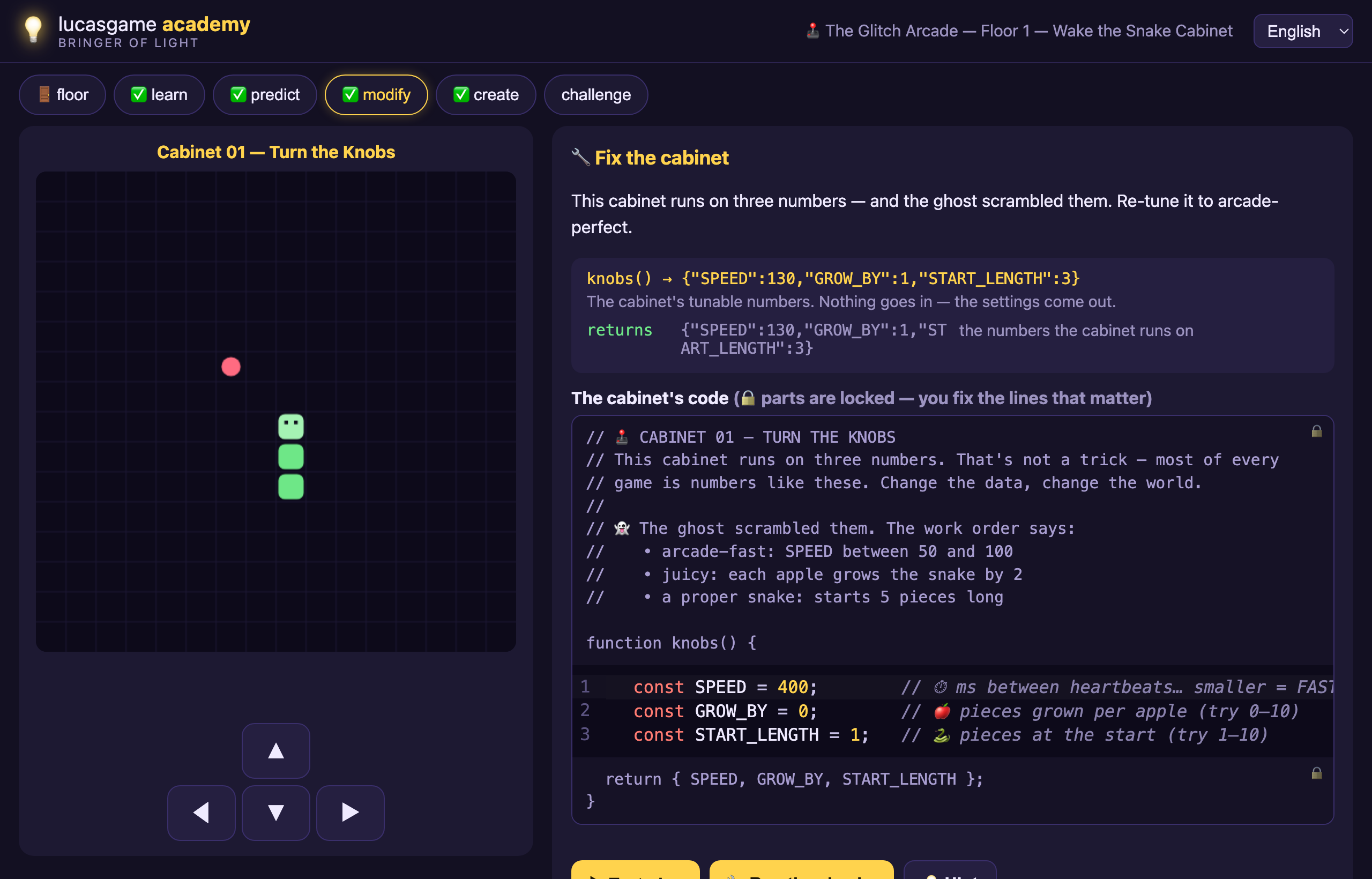
In The Glitch Arcade, a child reads broken arcade code, predicts what it will do, and flips the one token that's wrong. The artifact is tiny — a single character sometimes. The judgement is the whole thing: they had to understand the program to know which token, and why.
In Snake-Lab, a child tunes a bot and watches the match. The settings they chose, plus the game that followed — including the times the bot "won" by reward-hacking a rule — are a complete record of a hypothesis and its test. You can read their thinking off the replay.
In Monkey Republic, a child changes a world's assumptions and watches cooperation or mistrust emerge. The dial settings and the resulting graph are an argument: "in a world like this, this is what happens." That's a thinking artifact about society itself.
In the Computational Art Studio, the reaction-diffusion rule a child tuned, the function brush they wrote, the photo they chose to let the algorithm see — the image and the choices that produced it are inseparable. The process is visible in the result.
The simplest one of all: a child asks an AI something, notices it's wrong or incomplete, and rewrites it — leaving their correction visible next to the original. That single act of doubt-and-repair is worth more, as evidence, than a flawless answer they merely accepted.
Thinking artifacts climb the Creation Ladder
Artifacts also let you see where a child is on the path from consuming to contributing. We call that path the Creation Ladder, and each rung tends to leave a richer artifact than the one below it.
- Consume
- Understand
- Modify
- Create
- Teach
- Contribute
Creation isn't a sudden leap from nothing to genius. It's a climb — from reading someone else's work, to changing it on purpose, to making your own, to helping someone else up the ladder behind you.
A child who only consumes leaves no artifact worth reading. A child who modifies leaves a diff you can inspect. A child who teaches leaves an explanation that reveals how deeply they understood. The higher the rung, the more of their thinking becomes visible — which is exactly what we want to be able to see.
How to read a thinking artifact
You can practise this at home with anything a child makes with a tool's help. Don't ask whether it's finished. Ask what it reveals:
- What did the child decide here that the tool did not?
- Can they point to the part they changed, and say why?
- Is there a rejected version — something they tried and threw out?
- Did they predict an outcome before testing it?
- Could they teach the next child how they did it?
Make one in five minutes
With a kid, ask an AI assistant any real question you have. Read the answer together and find one thing that's wrong, weak, or missing. Rewrite just that part, and keep the original visible beside it. You've just made a thinking artifact — and modelled the one move that matters most.
Read: learning in the age of AI →