Lecture preview · Trust, incentives, belief
Monkey Republic
A simple game about monkeys and bananas becomes a deeper classroom experiment: when the rules of the world change, do trust and morality still mean the same thing?
Visual preview
See the simulation before the lecture
The preview mixes short videos and clear snapshots: feel the question first, then compare the rules and simulations that explain it.
ChatGPT honest view
This topic is genuinely strong. Not because it says “cooperation is good,” but because it refuses to stop there. It lets students test the uncomfortable question: if a world rewards betrayal, how do I understand myself, how should I think, and what kind of world should I help create?
The question behind the game
The game has only two buttons, but the lesson is not small. Students learn that strategies, incentives, memories, reputation, and beliefs all shape behavior.
Two choices
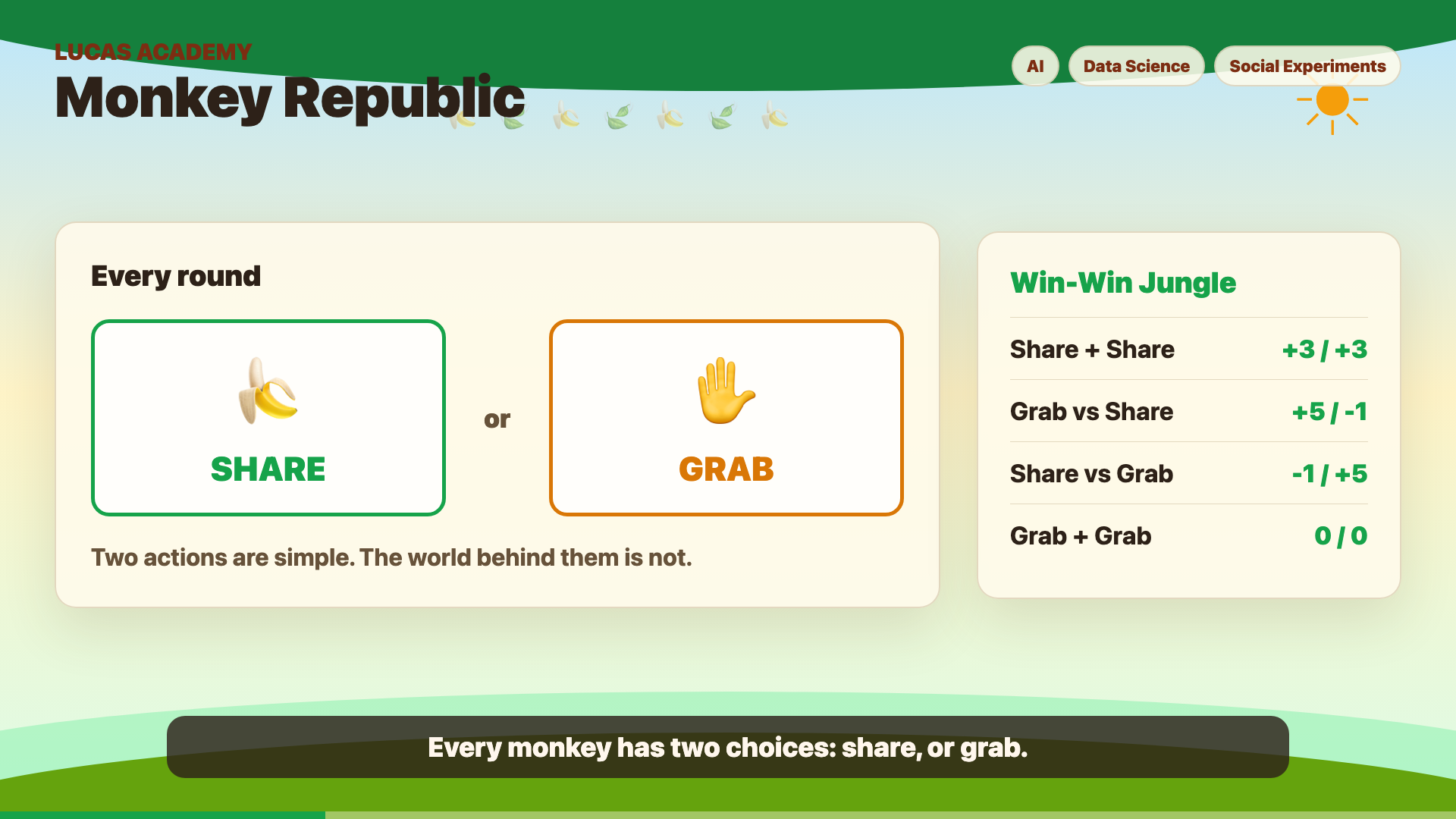
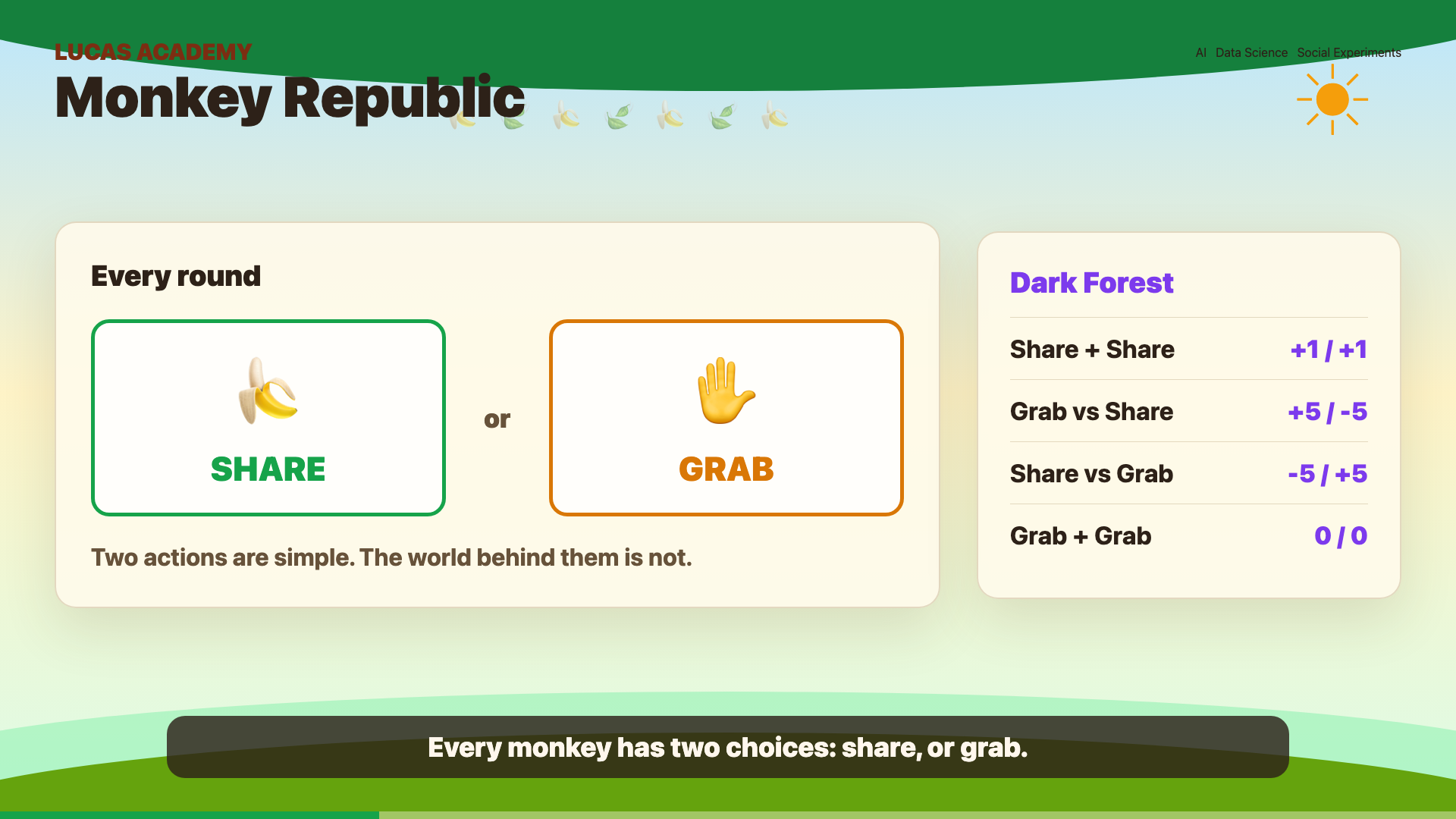
Share means taking the risk to cooperate. Grab means protecting yourself, or exploiting someone else’s trust.
Different worlds
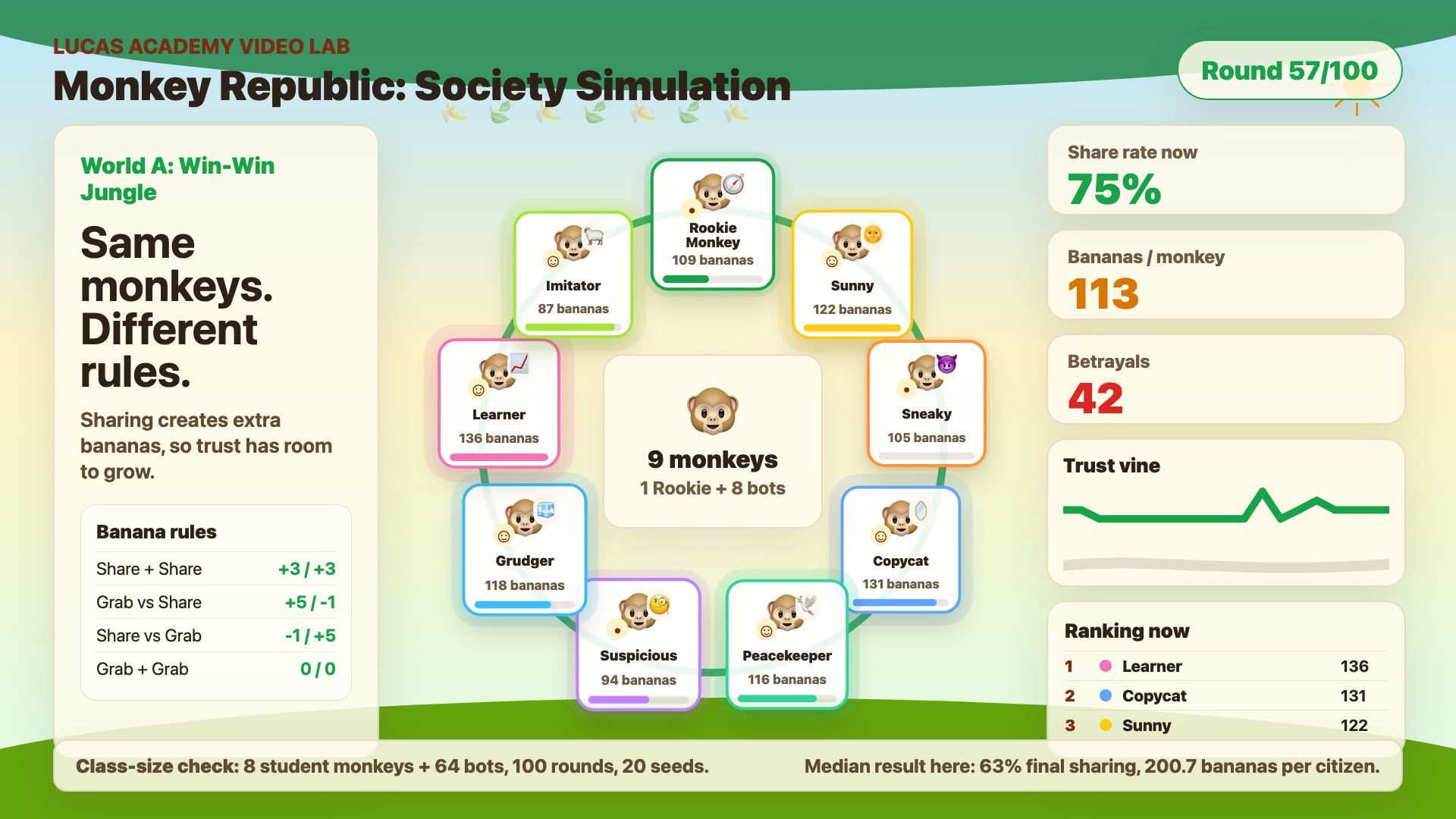
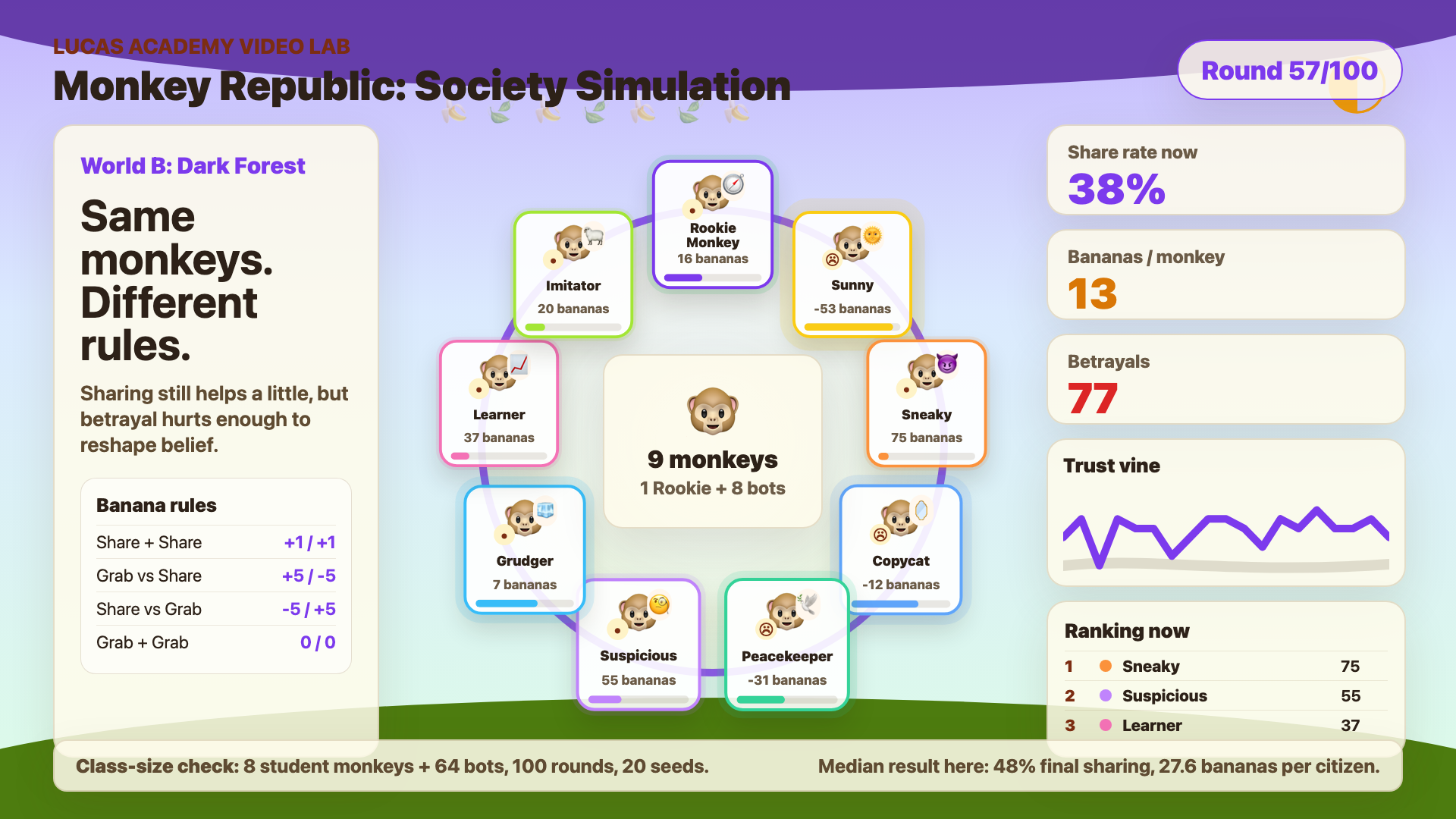
In one world, cooperation creates more bananas. In another, betrayal is rewarded and being betrayed is painful.
One deeper question
If the world can train strategies, how do we understand ourselves, think with curiosity, and contribute to real-world problems that matter?
Simple first version
12 Core Ideas
It is one compact lecture path: the teacher would choose which ideas to emphasize through game play, simulation, and discussion.
-
Start with Monkey Republic
Students meet the game as a small society, not as a lecture about morality.
-
Name the real question
If cheating wins, is goodness still meaningful, or was it only a smart strategy?
-
Learn the two buttons
Share and Grab are easy to understand, so students can focus on consequences.
-
Show the banana math
Clear payoff numbers make every conclusion testable instead of sentimental.
-
Change the world rules
Win-Win Jungle, Zero-Sum Grove, Dark Forest, and Forgiving Village teach different lessons.
-
Introduce belief
Belief means what a monkey thinks the world is like, and that belief shapes action.
-
Meet the monkey personalities
Sunny, Sneaky, Copycat, Suspicious, Learner, Imitator, and others become thinking models.
-
Run a class society
Eight student monkeys and sixty-four bot monkeys make the classroom feel like a real social system.
-
Watch the world train behavior
The same monkeys behave differently when the reward structure changes.
-
Separate smart from good
A strategy can win bananas and still raise a moral question.
-
Discuss the conditions for trust
Memory, reputation, repair, and forgiveness decide whether cooperation can survive.
-
Leave with a question
Now that students can see how world rules train strategies, they ask how to understand themselves, think clearly, search for significance, and contribute to real-world problems that matter.
Real simulation data
A few numbers worth showing
The lecture uses real runs from the Monkey Republic simulation engine. The first page should show the pattern, then the deeper slides can show the full tables.
Class society, 100 rounds
200.9 → 27.8Bananas per monkey dropped sharply from Win-Win Jungle to Dark Forest. The same society changed when the world rules changed.
Betrayal is trained too
986 → 1,662Betrayals rose sharply in the class society when betrayal became more rewarding and more painful to suffer.
Large society, 500 rounds
7,645Dark Forest produced 7,645 betrayals in the class-size simulation. That is not one bad choice. It becomes a social climate.
Important: these are model results, not proof about all real life. The point is to teach students to ask what assumptions the model is using, and how conclusions change when the assumptions change.
Deeper research coming
Where the full class goes next
The first webpage should stay simple. The full lecture can go deeper with teacher-led experiments and class discussion.
Memory: monkeys remember who hurt them, not just whether the world is good or bad.
Reputation: in a larger society, public history starts to matter more than private feeling.
Learning: bots adjust when the world rewards a behavior, even if the behavior is not noble.
Imitation: when students copy winners without asking what is right, bad behavior can spread.
Teacher mode: teachers will change world rules, society size, and the number of simulation rounds.
Moral reflection: students discuss how to protect themselves without becoming shaped entirely by fear.
This is a first public doorway for the Monkey Republic lecture. The deeper research, classroom experiments, and discussion slides will continue to grow.
Teacher reflection
Mr.Yancy Comment About This Lecture
This lecture is not a trick to prove that nice behavior always wins. It is a way to help students notice how a world can train the mind. A child who learns only to adapt to the reward may become clever, but not necessarily wise. The deeper question is how we understand ourselves, renew our thinking, and use what we learn to serve real problems that matter.
“Do not conform to the pattern of this world, but be transformed by the renewing of your mind. Then you will be able to test and approve what God’s will is—his good, pleasing and perfect will.”
Romans 12:2