
Essay · Teaching practice
Differentiated Instruction: Helping Every Kid Get Back on Track
Kids really are different from one another. We give more support to the kids who need it most, set kids up to teach and learn from each other, build relationships first, and grow a habit of asking for help, until the four make a cycle that keeps itself going.
In plain words
Here is where our thinking is. When you really care about your students, you feel how different kids are from one another. The ones who fall behind are having a hard time, so you want to get them back on track, and fast. We have always given more of our time to the kids who need it most, and in a small class it clearly works. But there is a cost: the strong students get less of our attention, and the bigger the class, the more it shows.
So what we are trying now is setting kids up, on purpose, to help each other. It is not a fixed “strong kids help the kids who are behind.” Every kid is good at something. Today you teach, tomorrow you learn. Teaching and learning complete each other and benefit each other, and the kid who does the explaining understands better too.
Then we found that the help that actually works rests on relationships. Middle schoolers care a lot about what others think, so asking for help is hard. So we set aside class time just to get to know each other: your favorite food, the best part of your week, or a greeting at the door. A hug, a high five, or a wave, your choice, and you can always sit it out. Once the relationships are there, the helping really gets going.
What we most want to grow is a habit of asking for help: ask a classmate, ask the teacher, and look for help outside. We ask for help ourselves, and we go first. Over time it becomes a cycle: get to know each other, help each other, ask for help, get back on track, and grow closer again. And a kid who is really stuck gets more support from the school’s team.
Differences are real
Kids the same age can be far apart in what they already know, what they care about, and how they learn. Using different materials, strategies, and activities so that different kids can reach the same goal is what educational psychology calls differentiated instruction (Snowman & McCown, 2015, p. 116).
The differences land on the kids. In an Edutopia film about Response to Intervention, a teacher says that a child who is completely lost in a general classroom all day is worn down “emotionally, socially, and academically.” We see the same in our own rooms, which is why we want to bring the kids who fall behind back quickly.
Differences are not a verdict either. The same textbook reminds teachers that an intelligence score is an estimate from one test at one point in time, and that it can change as knowledge and learning change (p. 120). Getting back on track is a goal kids can actually reach.
More for those who need it most, and what it costs
We have always given more of our time to the kids who need the most help. It is the same principle behind MTSS, the framework most American schools use: the amount of support follows the need. In a small class, we can see the difference clearly.
The cost is just as clear. A teacher’s time is limited. More time with the kids who are behind means less attention for the kids who move fast, and the bigger the class, the more it shows. The textbook says so plainly: in a class of twenty-five or more, no teacher can meet every need of every student at every moment, and that is no reason to give up on differentiation (p. 146).
Learning from each other: today you teach, tomorrow you learn
What we are trying now is to set kids up, on purpose, to help one another. The textbook describes a sixth-grade writing class where students list what they want to improve and classmates who are good at it help them, which frees the teacher to meet with every student individually twice a month (p. 146). Peer help answers the cost in the last section.
The roles do not stay fixed. Every kid is good at something, and one person’s abilities can differ a great deal from one area to another (the textbook’s account of Gardner’s multiple intelligences, pp. 124–126). The kid who struggles with reading may be the best at drawing in the room. Today you teach; tomorrow you learn. This is “learning from each other” in our whole-person education principles: teaching and learning complete each other and benefit each other.
The helper learns too. A meta-analysis of school tutoring programs found clear gains for the students who were tutored, and small but real academic gains and better attitudes toward the subject for the tutors themselves (Cohen, Kulik & Kulik, 1982). PALS, a peer-tutoring method used in many American schools, has partners take turns as coach and reader, and its developers place it in Tier 1 of MTSS, the teaching every student gets.
Relationships first
We have found that the help that works rests on relationships. Kids care a great deal about what their peers think; the textbook notes that the desire to conform peaks in the middle school years (p. 96). Saying “I don’t get it” in front of classmates is a risk. A study of fifth graders found that kids focused on social status, or on looking smarter than others, were more likely to avoid asking for help, while kids who valued close friendships avoided it less (Ryan, Hicks & Midgley, 1997).
So we set aside class time just for getting to know each other: your favorite food, the best part of your week, or a greeting at the door (a hug, a high five, or a wave; the kid chooses). Anyone can sit it out, any time. The questions can change; the principle stays the same: light, voluntary, and a chance to be seen.
Once the relationships are there, the helping really starts to move.
Asking for help is a skill
What we most want to grow is a habit of asking for help. Asking is a skill, and a strong one: ask a classmate, ask the teacher, and look for help outside the room.
The habit needs people to go first. Kids who need help ask, kids who move fast ask, and teachers ask too: we ask colleagues and talk things through with the team. When kids hear a teacher say “I need help with this,” asking stops being embarrassing.
A cycle that keeps itself going
Put together, it is a cycle: get to know each other, help each other, ask for help, and get back on track. The helpers grow too, the relationships get a little closer, and the cycle goes around again.
The cycle lives in the classroom. In the language of American schools, it belongs to Tier 1 of MTSS (Multi-Tiered System of Supports): good teaching for every student. The academic side of MTSS is called RtI (Response to Intervention), and the behavior side is PBIS. When classroom help is not enough, the school’s team adds small-group support (Tier 2) or one-on-one support (Tier 3) and checks each kid’s progress regularly. Peer help does not replace that.
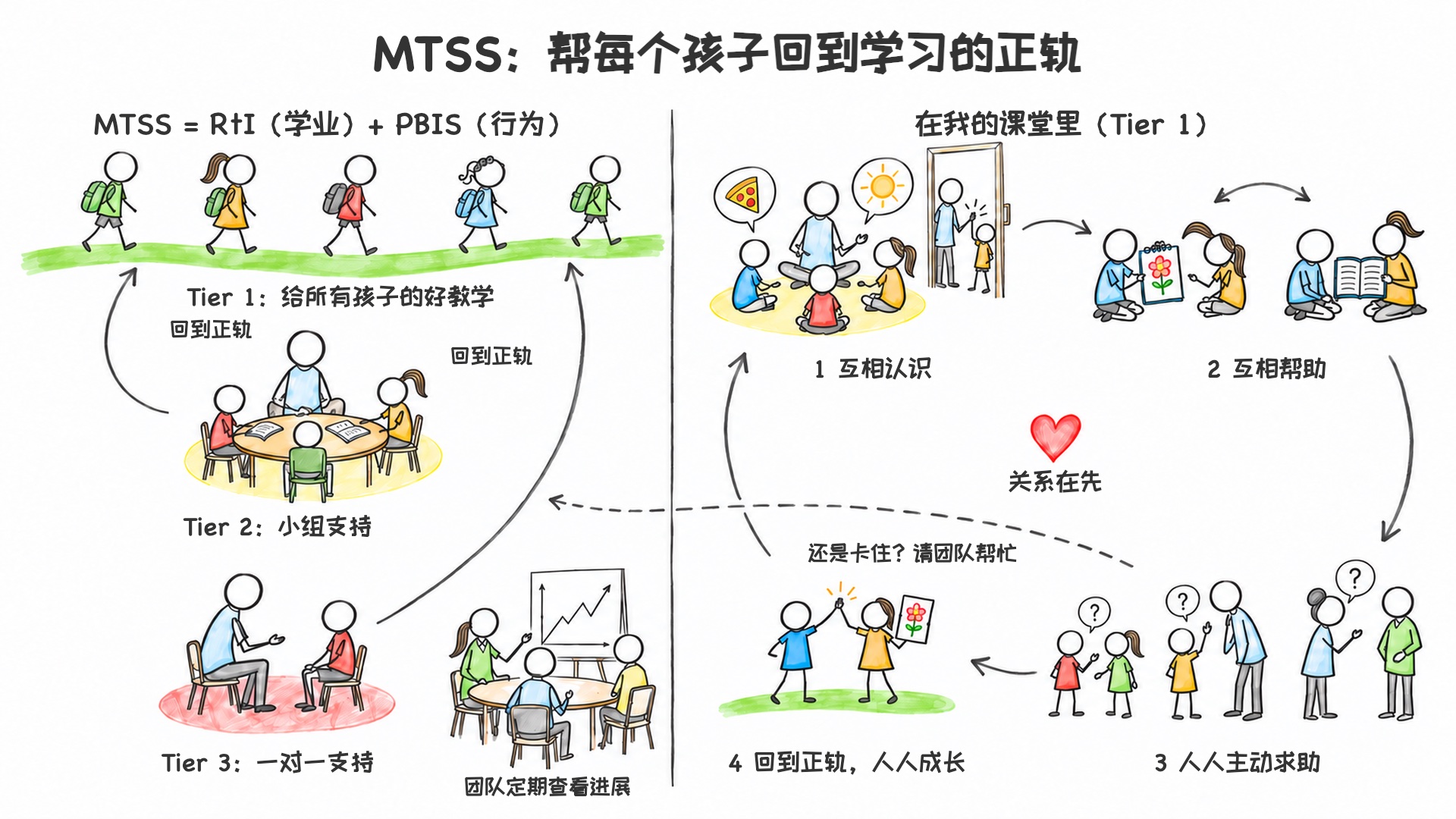
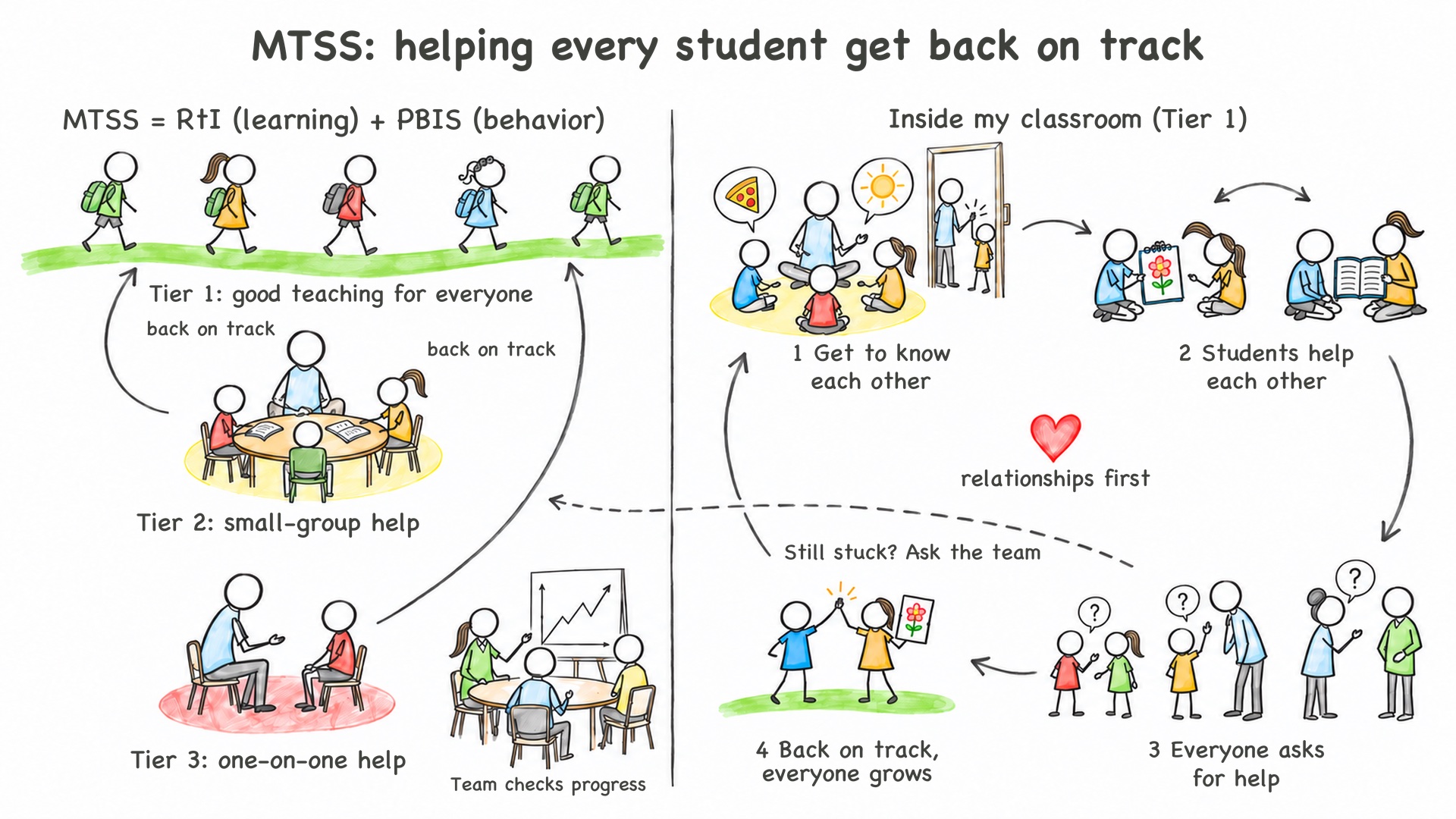
A tier is where a kid is right now, not a label. The goal is always the same: back on track.
Sources
- Snowman, J., & McCown, R. (2015). Psychology applied to teaching (14th ed.). Cengage Learning. Pages cited: 96, 116, 120, 124–126, 146; RTI at pp. 203–204.
- Cohen, P. A., Kulik, J. A., & Kulik, C.-L. C. (1982). Educational outcomes of tutoring: A meta-analysis of findings. American Educational Research Journal, 19(2), 237–248.
- Ryan, A. M., Hicks, L., & Midgley, C. (1997). Social goals, academic goals, and avoiding seeking help in the classroom. The Journal of Early Adolescence, 17(2), 152–171.
- IRIS Center, Vanderbilt University. Overview of PALS (Peer-Assisted Learning Strategies).
- Park, Y., Chow, K., & Gracely, S. Multi-tiered frameworks: Understanding RTI, PBIS, and MTSS. SRI Student Behavior Blog.
- Edutopia. Response to Intervention: Collaborating to Target Instruction (video).
Related reading
Where “learning from each other” comes from, along with the other four principles, is in The Foundations of Whole-Person Education. More essays, field notes, and parent resources are in Research & Notes.