The old question
For a long time, education asked a fairly settled question: what skills should a child acquire? Reading, arithmetic, then typing, then coding. The plan was to load a young person with capabilities and send them into a world that would pay for those capabilities.
That question isn't wrong. It's just no longer sufficient. A tool now sits beside every child that can write an essay, debug a program, translate a paragraph, or generate a picture in seconds. If the whole goal was to be able to produce those things, the goal just got strange.
What AI actually changes
The tempting reaction is to declare that "AI changes everything" and move on. It doesn't change everything. It changes one specific, important thing: producing a plausible answer is no longer proof that a person understood anything.
A child can hand in a working program they cannot read. A polished paragraph they could not have judged. A picture they did not decide anything about. The output looks like the output of learning, but the learning may simply not be there.
So the useful questions move. Not "can you produce this?" but: Can you tell whether it's any good? Can you find the one thing that's wrong with it? Can you change it on purpose and predict what your change will do? Can you explain why you kept some of it and threw the rest away?
In the age of AI, the scarce skill is not generating an answer. It is judging one, and knowing what to do next.
The Human-AI Interface Loop
A child is not training to be replaced by AI, and they're not training to passively consume it either. They're learning to be a good interface partner — someone who can sit at the boundary between a person and a powerful tool and act well there. We call the pattern the Human-AI Interface Loop.
- Ask
- Inspect
- Doubt
- Modify
- Test
- Explain
- Ask better
The value isn't in the first ask. It's in doubting the reply, changing it on purpose, testing whether the change helped, and coming back with a sharper question. The loop is the skill.
Notice what's in the middle: inspect, doubt, modify, test. Those are exactly the moves that disappear when a child just accepts what a machine hands back. An education for this age is, in large part, a set of reasons and places to keep those middle steps alive.
Thinking artifacts
If finished output no longer proves learning, what does? Our answer is the thinking artifact: any visible thing a student makes that reveals how they thought — the change they chose, the strategy they tuned, the answer they corrected, the trace of judgement left behind.
A single fixed line of game code. A bot's settings and the game it went on to win or lose. A rewritten AI answer with the student's correction still visible. None of these are impressive as products. All of them are excellent as evidence. This idea is important enough that it has its own essay.
What it looks like at Lucas Academy
None of this is abstract for us, because almost everything a child does here already produces a thinking artifact and already runs some version of the loop.
A real arcade game is running, and its code is broken on purpose. The child doesn't write it from a blank page — they read it, predict what it will do, find the one token that's wrong, and flip it. The fix is small; the judgement is the whole point. That's inspect → doubt → modify → test in about ninety seconds.
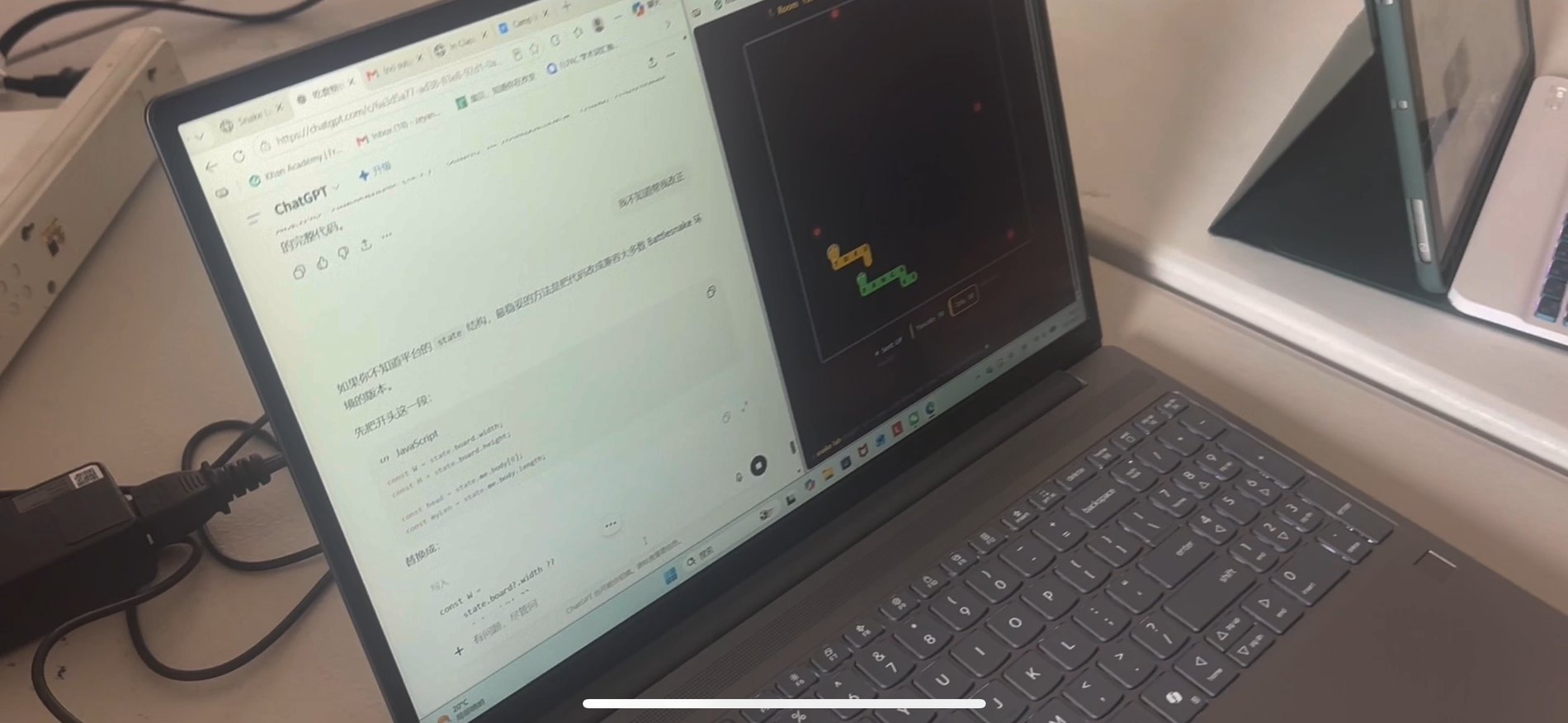
A child tunes a snake bot and sends it into the arena. Sometimes it wins by playing well; sometimes it "wins" by exploiting a loophole in the rules — reward hacking, in miniature, right in front of them. Then they open the code and see why. The strategy they chose, and the result it produced, are the artifact.
Computer vision and simulation become materials, not magic. A child doesn't ask a machine to make a picture — they decide what it sees and how it transforms, adjusting a function brush or a reaction-diffusion rule until the image says what they meant. The choices are visible in the result.
Across games, code, simulation, and art, the shape is the same: the child is never just a consumer of an output. They are the person at the interface, making the choice that changes the result — and leaving a trace of it.
What parents and educators can do
You don't need to run a lab to teach this. You mostly need to change the question you ask when a child shows you something a machine helped make. Instead of "did it work?", try noticing these:
- Did the child only receive an answer, or did they inspect it?
- Did they make a choice that changed the result?
- Can they explain why they changed it?
- Did they test or compare alternatives, rather than accepting the first output?
- Does the work reveal something about their thinking, not just the tool's?
- Did the activity point beyond a personal score toward something worth doing?
Ninety seconds at the interface
Open The Glitch Arcade with a kid and pick one broken game. Before touching anything, ask them to predict what the code will do. Run it. Then find the single wrong token together and flip it. The point isn't the fix — it's the moment of doubt before it.
Open the Arcade — free